
A Good Vibe Show Exclusive
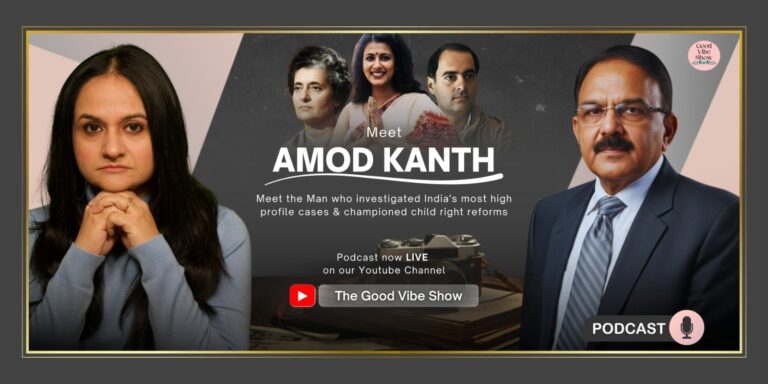
From India’s most turbulent political assassinations to the silent struggles of vulnerable children, Amod Kanth has lived a life that reads like the script of a gripping documentary.
As one of the most decorated IPS officers of his era, he investigated defining cases of modern India — the assassination of Indira Gandhi, Rajiv Gandhi, the Delhi riots, the Jessica Lal case, and countless high-pressure operations.
Yet behind the uniform was a man who believed justice is incomplete without compassion.
In 1988, a devastating slum fire in Delhi led him to create Prayas, an organisation that now supports thousands of children daily across India.
His journey — from crime scenes to child-rights reforms — proves that true service goes beyond duty; it comes from the heart.
“The world around you teaches you everything — if you are willing to feel someone else’s pain.” — Amod Kanth
The Journey of a Fearless Reformer
Born in a humble family in Rajasthan, Amod Kanth grew up believing that courage and character were a person’s greatest assets.
He joined the Indian Police Service in 1974, stepping directly into an era of civil unrest, terrorism, and riots.
As Delhi’s top investigator, he handled cases without modern tools — no CCTV, no digital forensics, no mobile tracking.
Just instincts, intelligence, and an unwavering sense of duty.
His role during 1984–1991 placed him at the core of India’s turning points, where every decision carried life-altering consequences.
Through it all, he stayed firm, ethical, and human.
When Policing Becomes Humanity
The turning point of his life came in 1988, after the Jahangirpuri slum fire. Hundreds of children stood abandoned, confused, alone.
That night he realized — crime needs investigation, but society needs healing.
From two modest rooms, Prayas was born — a movement that would grow into one of India’s largest child-rights organisations, with:
- 320+ centres
- Operations across 13 states
- 4,000–5,000 children supported daily
- Landmark work influencing the Juvenile Justice Act & POCSO reforms
His approach combined policing, social care, and empathy — a unique blend that redefined public service.
“Justice is not just about courts and crime. It’s about giving people hope.” — Amod Kanth
Reforming India’s Child Protection System
Amod Kanth led India’s first national study on child abuse, revealing uncomfortable truths that shaped major reforms:
- POCSO Act (2012)
- Juvenile Justice Act improvements
- Child protection frameworks across India
- Post-Nirbhaya reforms for women & children
He proved that true reform begins not in law books — but in confronting harsh realities with compassion.
Life Beyond the Uniform
Even after retirement, he remains deeply active:
- Heads Prayas as a full-time reformer
- Writes books on policing & social justice
- Mentors policymakers and law students
- Advocates for children, women, and vulnerable communities
His daily routine is simple: discipline, focus, and service.
His Message to India’s Youth
He believes that young Indians hold the power to reform the nation — morally and socially.
His guiding mantras:
- Stay aware — ignorance is society’s biggest danger
- Feel responsible — injustice anywhere affects everyone
- Have courage — truth demands bravery
- Serve others — even small acts create big change
- Spread positivity — kindness strengthens society
“Life is tragic — but we must refuse to take it tragically.” — Amod Kanth
🎧 Watch the Full Episode
Discover the untold stories from India’s biggest cases, the rise of Prayas, and the inspiring human being behind the IPS badge — only on The Good Vibe Show.
🎥 Watch Now: From Assassinations to Prayas: The Untold Journey of IPS Amod Kanth
🔗 Click to Watch the Full Episode
Frequently Asked Questions
1) What major cases did Amod Kanth investigate?
He was involved in the Indira Gandhi assassination, Rajiv Gandhi blast investigation, Delhi riots, Jessica Lal case, BMW hit-and-run, and multiple anti-terror operations.
2) Why did he start Prayas?
A 1988 slum fire exposed the suffering of abandoned children. He realized policing alone couldn’t help society’s most vulnerable — so he founded Prayas to protect and empower them.
3) How did his work influence Indian law?
His national study on child abuse became a key reference for POCSO (2012). He contributed significantly to the Juvenile Justice Act reforms and rehabilitation models for children
4) What does he consider his toughest challenge?
Investigating high-profile cases without modern technology while facing political pressure, media scrutiny, and threats from extremist groups.
5) What keeps him motivated?
His belief that justice must be meaningful and compassionate — not mechanical. He sees service as a lifelong mission, not a job.
6) Is he still active after retirement?
Yes. He leads Prayas full-time, writes books, mentors youth, and advocates for better child protection systems.
7) What message does he give to young Indians?
Be courageous, stay kind, learn from society, and take responsibility for creating positive change.
8) How can people support Prayas?
By sponsoring a child, donating, volunteering, spreading awareness, or contributing to Friends of Prayas (India/USA).